
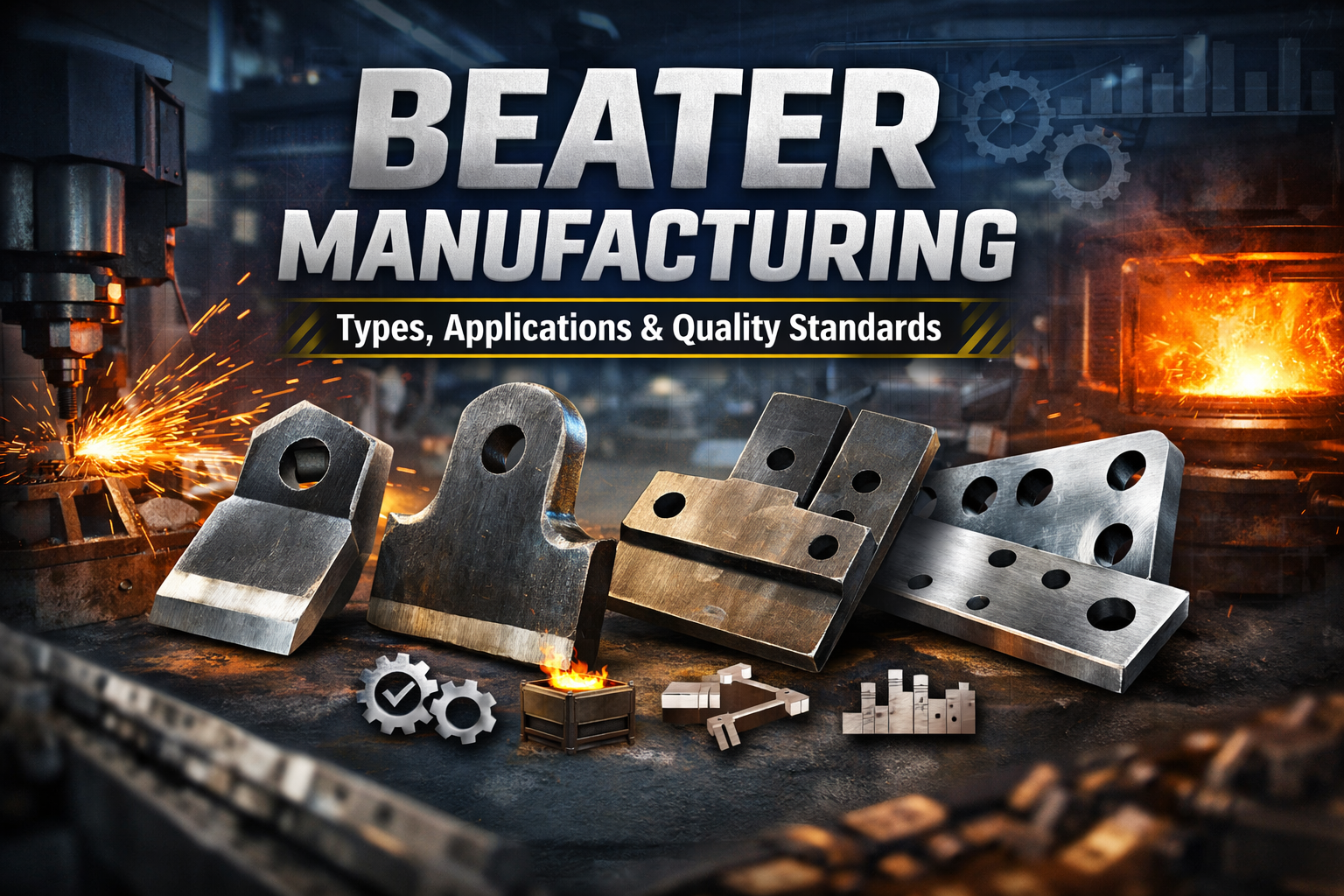
In industrial processing environments, precision and durability are not optional — they are operational necessities. Industrial beaters play a critical role in mixing, crushing, agitating, and material processing across multiple industries.
For businesses operating in high-performance environments, selecting the right beater manufacturer directly impacts efficiency, machine longevity, and production output.
This guide explains the fundamentals of beater manufacturing, the types of beaters available, material selection standards, and key factors to consider before procurement.
1. What is an Industrial Beater?
An industrial beater is a rotating component used in machinery to process, agitate, crush, or mix materials. Beaters are commonly installed in:
-
Flour mills
-
Pulverizers
-
Feed mills
-
Sugar processing plants
-
Agricultural machinery
-
Recycling and crushing units
-
Paper & pulp processing systems
The performance of the entire machine often depends on the structural integrity and precision engineering of the beater.
2. Types of Industrial Beaters
Different applications require different structural designs and metallurgy. Below are the most common types manufactured in the industry:
A. Hammer Beaters
Used primarily in hammer mills and pulverizers.
Key Features:
-
High impact resistance
-
Hardened edges
-
Balanced weight distribution
-
Designed for crushing and grinding
B. Swing Type Beaters
Designed to rotate freely during operation.
Advantages:
-
Reduced machine vibration
-
Lower wear rate
-
Improved energy efficiency
C. Fixed Rigid Beaters
Used in heavy-duty processing environments.
Best For:
-
High-capacity grinding
-
Continuous industrial use
-
Hard material processing
D. Customized Precision Beaters
Engineered according to machine specifications.
Customization includes:
-
Thickness variation
-
Alloy composition
-
Hardness level
-
Surface treatment
-
Hole size and alignment accuracy
3. Material Selection in Beater Manufacturing
Material composition determines durability and wear resistance. High-quality manufacturers typically use:
-
High Carbon Steel
-
Alloy Steel
-
Manganese Steel
-
EN-series Steel Grades
-
Tool Steel (for high abrasion environments)
Why Material Matters
Incorrect material selection can result in:
-
Premature wear
-
Shaft imbalance
-
Increased downtime
-
Reduced machine efficiency
Heat treatment processes such as hardening and tempering are crucial to enhance tensile strength and impact resistance.
4. Manufacturing Process of Industrial Beaters
A reliable beater manufacturer follows a structured production process:
Step 1: Raw Material Inspection
Ensuring chemical composition and structural integrity.
Step 2: CNC Cutting / Plasma Cutting
Precision shaping based on engineering drawings.
Step 3: Drilling & Slotting
High-accuracy hole placement for alignment stability.
Step 4: Heat Treatment
Hardening to increase wear resistance.
Step 5: Surface Finishing
Grinding and polishing for dimensional accuracy.
Step 6: Quality Testing
-
Hardness testing
-
Impact testing
-
Dimensional verification
-
Balance testing
Strict quality control ensures reduced vibration and longer operational life.
5. Applications Across Industries
Industrial beaters are widely used in:
Agriculture & Feed Industry
Grinding grains and producing animal feed.
Food Processing
Crushing and size reduction.
Chemical Industry
Material agitation and blending.
Paper & Pulp Industry
Fiber processing and pulp preparation.
Recycling Industry
Plastic and waste material processing.
6. Key Factors to Consider When Choosing a Beater Manufacturer
If you are sourcing beaters for industrial use, evaluate the manufacturer on:
✔ Material certification
✔ Heat treatment capability
✔ Customization options
✔ Production capacity
✔ On-time delivery record
✔ Technical support
✔ Industry experience
A manufacturer with in-house production and quality testing facilities ensures consistency and faster turnaround.
7. Why Quality Beaters Improve Operational Efficiency
Low-quality beaters often cause:
-
Increased power consumption
-
Frequent replacement
-
Higher maintenance costs
-
Machine imbalance
High-precision beaters, on the other hand:
-
Reduce operational downtime
-
Enhance grinding efficiency
-
Extend machine life
-
Improve ROI
Conclusion
Beaters may appear to be simple mechanical components, but their design, metallurgy, and manufacturing precision directly influence industrial productivity.
Partnering with a professional beater manufacturing company ensures:
-
High wear resistance
-
Accurate dimensional tolerance
-
Custom-engineered solutions
-
Long-term operational stability
If your operations demand durability, precision, and reliability — selecting the right beater manufacturer is a strategic investment, not just a purchase decision.
Recent Comments